
Generic vs Brand Medicines: Smart Choice for Better Savings

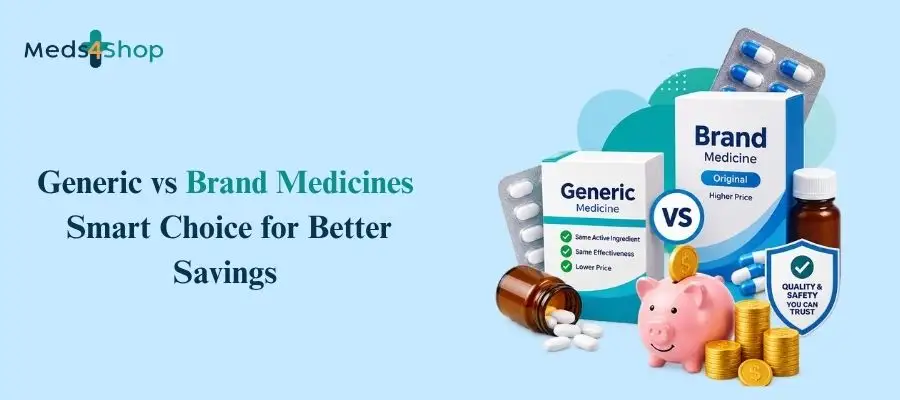
When you get a prescription, you’re usually given the choice to take either a generic or brand-name medicine. This might get you wondering, do generic medicines work as well as their branded counterparts and why are generics typically less expensive?
To be approved as a generic medicine, it has to offer the same therapeutic value as the brand medicine. In terms of branded medicines in the US, the FDA requires approved generics to contain the same active ingredients as the brand medicines, strength, dosage form, method of administration, and be similar in terms of safety and effectiveness.
Let’s take a look at some of the notable differences between branded and generic medicines from the patient’s perspective.
What Is a Brand-Name Medicine?
A branded or brand name medicine is a drug that is marketed by its original manufacturer.
Before a new medicine is approved, a manufacturer has to conduct expensive laboratory and clinical studies to demonstrate the safety and effectiveness of the medicine. After market approval, the manufacturer is granted patent and market exclusivity protection from competition for a certain period.
Examples of brand medicines include Cialis, Viagra, and Lipitor, among others. Generic versions may be approved once patents and market exclusivity protection expires.
What is a Generic Medicine?
Generic medicines contain the same active ingredients as the brand medicines, and are intended to work in the same way.
To gain FDA approval for a generic drug, the manufacturer must demonstrate pharmaceutical and bioequivalence. This means that a generic drug must have the same active ingredient as the brand name drug and that it reaches the body in the same amount of time in the same manner as the brand name drug.
Though generic drugs may look different from brand name drugs, this does not mean generic drugs are less effective. Generic drugs can have different colors, shapes, packaging, and inactive ingredients.
When considering appearance versus Active ingredients, Generic and Brand name drugs mean the same thing.
Generic medications are nearly always priced less than Brand name medications.
Generic vs Brand Medicines: Key Differences
| Feature | Generic Medicine | Brand-Name Medicine |
| Active ingredient | Same | Original |
| Strength | Same | Original |
| Intended effect | Same | Same |
| Quality standards | Required to meet regulatory standards | Required to meet regulatory standards |
| Appearance | May differ | Original design |
| Price | Usually lower | Usually higher |
| Manufacturer | Often a different company | Original manufacturer |
Are Generic Medicines as Safe as Brand Medicines?
Yes, when legally obtained.
The FDA states that approved generic medicines are the same as their brand name counterparts. Generic manufacturers must also meet regulatory requirements for identity, strength, purity, quality, and stability.
Generic medicines are also monitored like Brand name medicines, after they are approved.
Because of this, there is no reason to believe that Generic medicines are less safe than their Brand name counterparts.
Why Are Generic Medicines Cheaper?
One of the biggest misconceptions is that generic medications cost less because they are made with sub-standard components. That’s not the main reason.
New medicine innovations come at a heavy price. Research and clinical studies aren’t cheap. The original medicine-making company foots the hefty price tag. Generic medicine companies don’t have to pay to repeat original clinical studies. This is because safety and efficacy of an established medicine is not in question. Further, generic medicine companies don’t have to prove equivalence. They have to provide cited evidence that their product meets the stated specifications.
The race for generic medicine is fierce too. The FDA noted that the market entry of five generic medicines addressed 85% of the price reduction for the brand medicines.
Do Generic Medicines Work the Same Way?
When a generic medicine is approved, it is therapeutically equivalent to the brand medicine.
The FDA requires all generic medicines to contain the same active ingredient, the same strength, and the same dosage as the brand medicine. Further, generic medicines must be bioequivalent to the brand medicine.
Because of this, generics are expected to be clinically as effective as their brand medicine counterparts.
Medicines can’t be considered equivalent just because they have a similar name. Be sure to check the active ingredient, strength, instructions, and indication of use.
Why Can Generic Tablets Look Different?
Generic drug manufacturers are permitted to use as many variations of:
- Tablet colors
- Shapes
- Sizes
- Packaging
As long as the drug meets the required standards.
Generic drug manufacturers are not required to make a direct copy of the branded drug.
Looks matter less when talking about efficiency.
Is Generic Medicine a Good Choice?
When it comes to many patients, generic medicine is a sensible choice. It is combination of FDA approved quality and lower price.
There is also a case to be made that lower medicine costs can help ease the burden of medication adherence.
However, the correct medicine for you is dependent on your specific situation. There are instances where medicines are specific to the individual and so patients must abide by the advice given to them.
Choosing a Safe Generic Medicine Online
When purchasing medicine online, the legitimacy of the pharmacy is of the utmost importance.
Before placing an order, confirm that the online pharmacy:
- Provides details of each product.
- Lists the active ingredient and strength for each product.
- Documents all prescription requirements when they apply.
- Offers pharmacist or healthcare support.
- Identifies the business and contact information.
- Operates within the applicable laws for the region for which it is serving.
Avoid websites that sell medicines with unknown ingredients, poorly priced medicines, or no information as to the source of the product.
About Meds4Shop
Meds4Shop specializes in generic medications and offers low-cost healthcare options serves customers in the USA, UK, Australia and selected European countries in accordance with relevant laws and regulations.
Our focus is to provide additional details regarding generic medicines and their active ingredients along with strengths and uses to assist customers with informed decisions.
The local prescription requirements must always be checked and a doctor or pharmacist must be consulted to determine whether a patient is permitted to take a certain medicine.
Frequently Asked Questions
Are generic medicines as effective as brand medicines?
All generic medicines that are approved must be bioequivalent and must provide the same clinical benefits as their corresponding brand medicines.
Why are generic medicines cheaper?
Generics usually cost less because generic companies don’t have to invest as much as the original manufacturer to conduct the same clinical research studies. Generic medicines also become cheaper due to competition.
Can generic medicines look different?
Yes. While retaining the same regulatory requirements, a generic medicine can vary in color, size, shape and appearance as well as in some inactive ingredients.
Should I switch from a brand to a generic?
For many medicines, an approved generic can be an acceptable alternative. However, if a patient has doubts, they should talk to their doctor or pharmacist.
Final Thoughts
The differences between generic medicines and brand medicines are name, manufacturer, price and appearance.
Approved generic medicines must satisfy the same performance and quality standards that must be met by all medicines. In the United States, more than 90% of all prescriptions are filled with generic medicines.
Patients who are concerned about the cost of treatments can consider use of generic medicines as a substantial cost saving alternative, so long as the medicines are obtained from reputable sources.